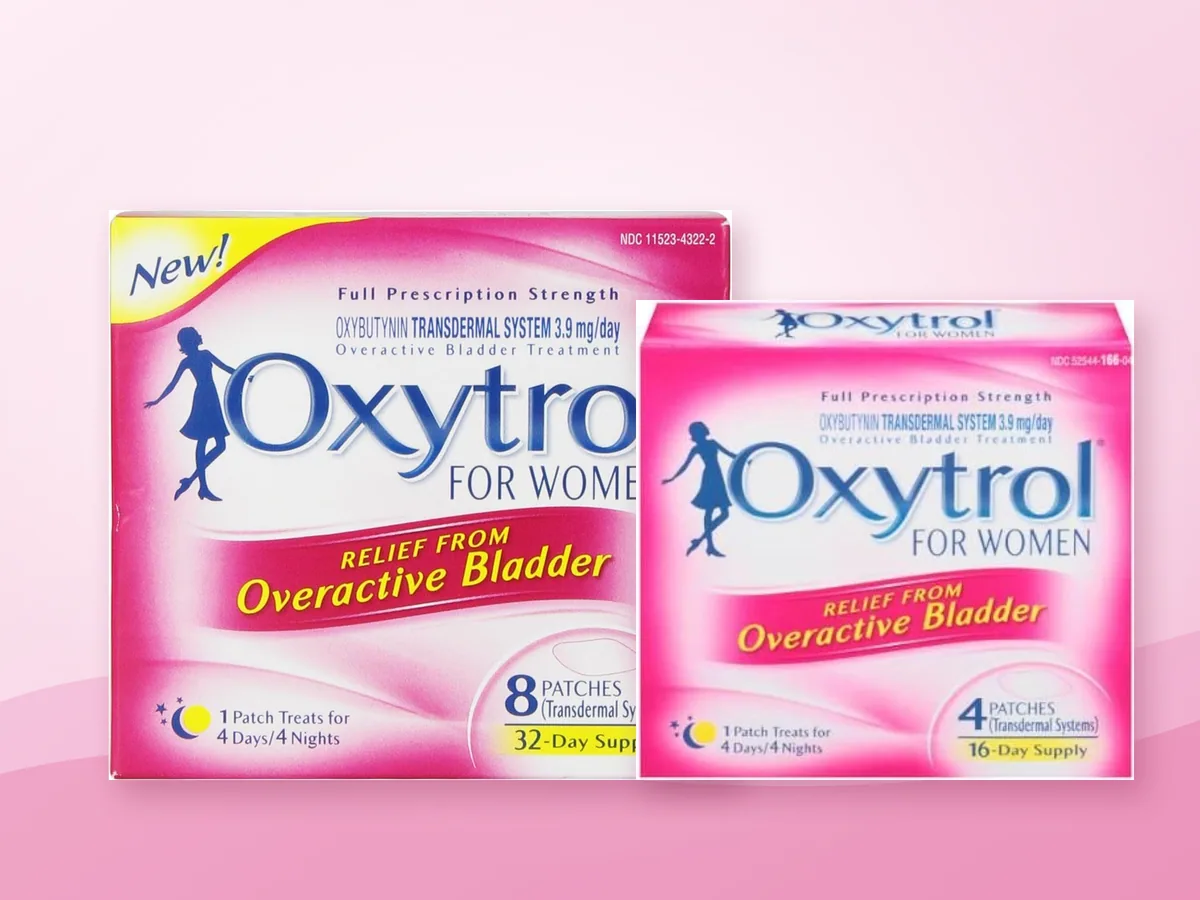
Boxes and prices
Oxytrol for Women Boxes and Packs: 4 or 8 Patches, How Long They Last, What a Day Costs
Four patches or eight, every pack priced per day, and the case for starting small.
The label
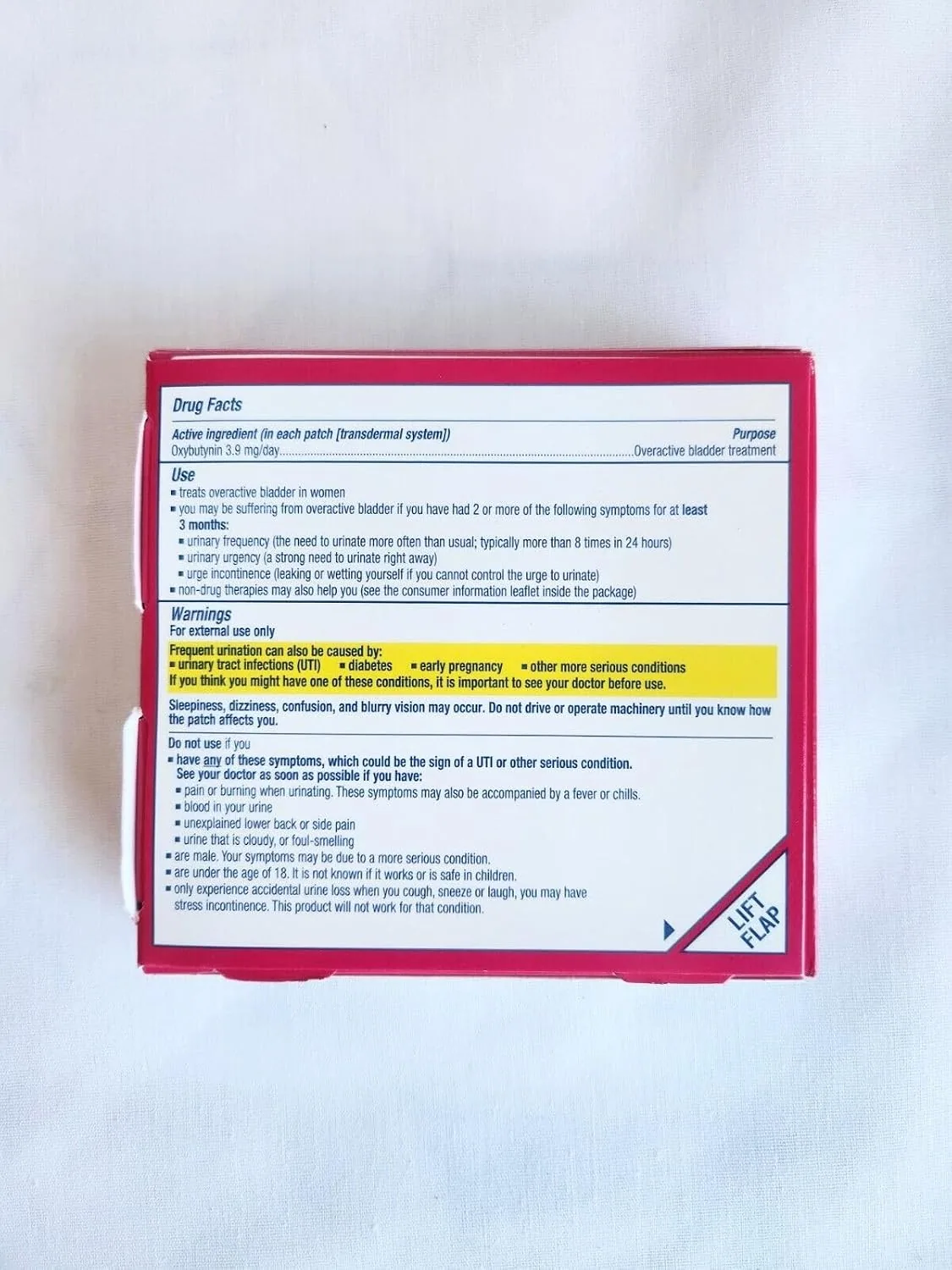
The back of the pink box holds every promise the product makes and everything you are asked to check. Here it is, one line at a time.
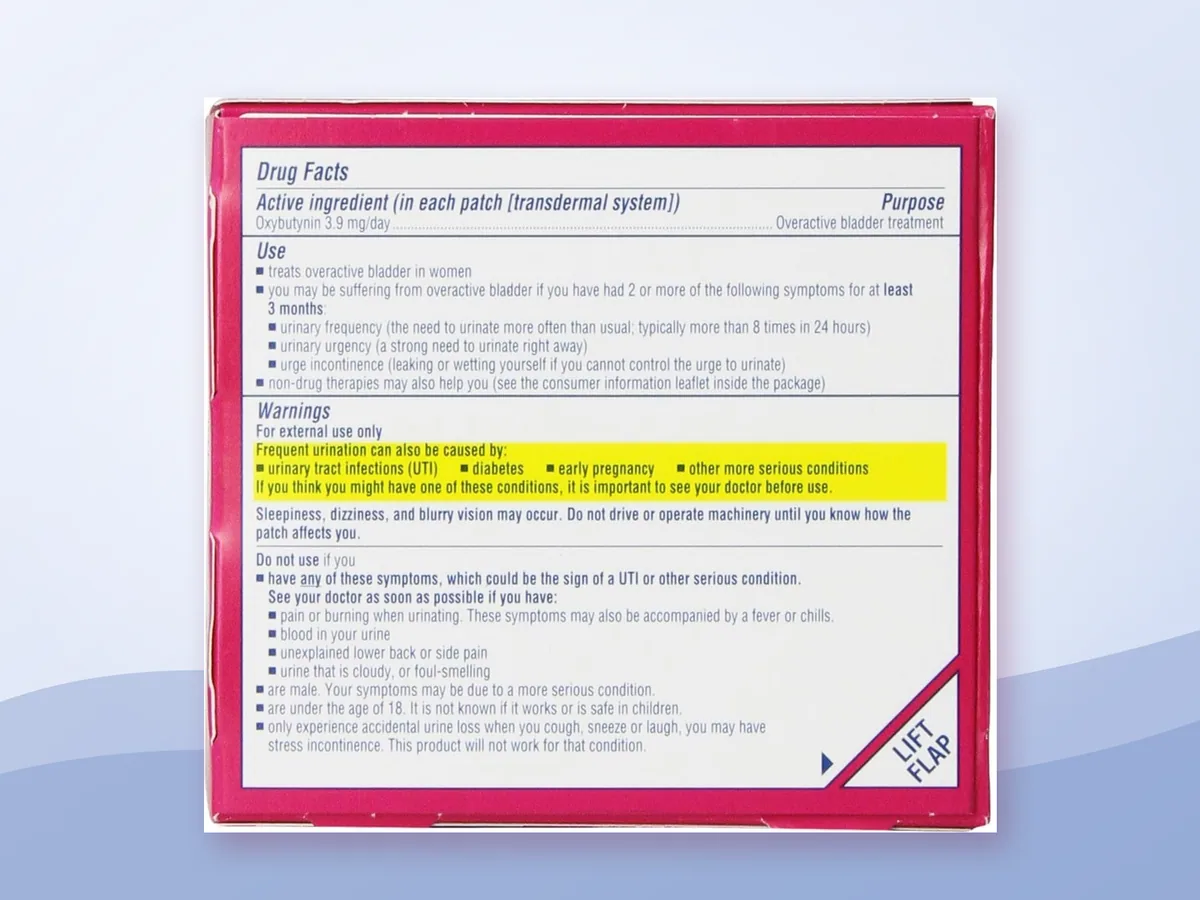
Every over-the-counter medicine sold in the United States carries a panel called Drug Facts. It has a fixed order: what is in the product, what it is for, when not to use it, how to use it. Oxytrol for Women is no exception. Its panel sits on the back of the box, and it is the most useful thing printed on the package.
Read it once from top to bottom and you will know three things: whether the patch is meant for you, how to wear it, and when to stop. Some lines are terse, so each section here comes with the exact wording and a plain reading of it.
The text comes from the label on file in the national label database, version 7, which we read on 8 October 2026. Your box may carry a newer or older printing. If your box reads differently, the box wins.
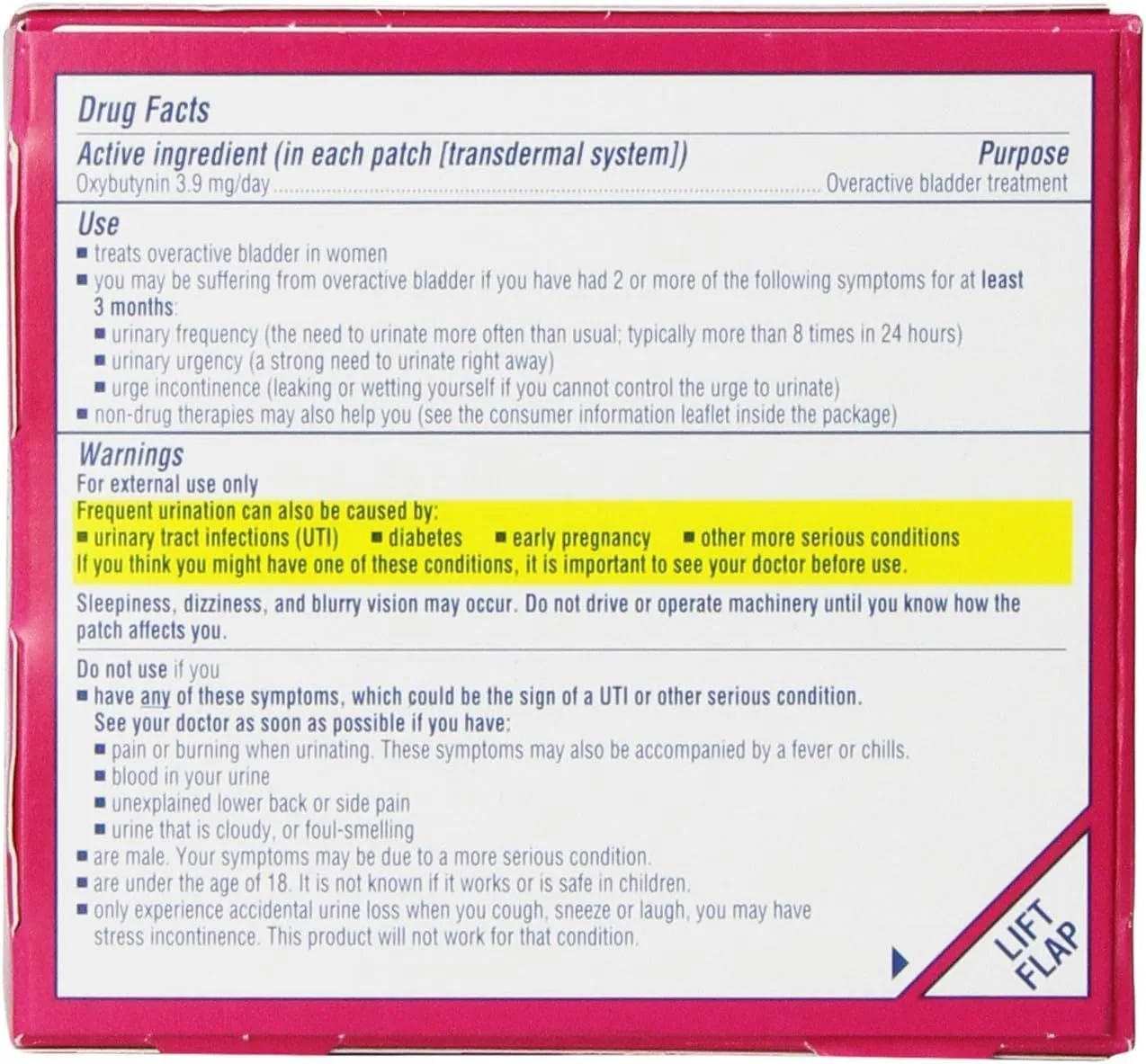
The U.S. Food and Drug Administration sets the layout, so every panel reads the same way. Once you know the order, you can find any answer in seconds. The agency describes the first two headings like this.
The substance(s) in the product that cause the intended therapeutic effect.
That is the definition of an active ingredient. The panel also gives a purpose, which is the product's category, and then the uses.
Symptoms or diseases the product will treat or prevent.
| Section | What it holds on this box | Why you would look there |
|---|---|---|
| Active ingredient | Oxybutynin 3.9 mg/day, in each patch | To know what the medicine is |
| Purpose | Overactive bladder treatment | To know its category |
| Use | Treats overactive bladder in women, with a three-symptom rule | To check that it matches your symptoms |
| Warnings | Who should not use it, when to ask a doctor, what may happen, when to stop | To check that it is safe for you to try |
| Directions | One patch, 4 days in a row, on abdomen, hips or buttocks | To wear it correctly |
| Other information | Sealed pouches, storage temperature, moisture | To store it |
| Inactive ingredients | 4 materials of the patch itself | To check for a known allergy |
| Questions? | A toll-free phone line with its hours | To ask the company |
If you came for one thing, jump to it: the warnings and the directions are the two sections buyers ask about most.
The first line names one active ingredient: Oxybutynin, 3.9 mg/day, in each patch (transdermal system). A transdermal system is the label's term for a patch that passes its ingredient through the skin. One system is one patch.
The number is a rate, not a total. The patch is built to deliver 3.9 mg in each day of wear, and you wear it for 4 days. You do not take anything by mouth.
Oxybutynin is not new. The U.S. National Library of Medicine describes the class it belongs to in one sentence.
Oxybutynin is in a class of medications called antimuscarinics.
The front of the box adds a phrase of its own: "Full Prescription Strength". There is history behind it. The patch was a prescription product first. FDA records show that Oxytrol for Women was approved on January 25, 2013 as a switch from prescription to over-the-counter sale, with the same ingredient and the same strength.
The purpose line next to it is short: "Overactive bladder treatment". That is the category the product belongs to, and it sets the limits for everything else on the panel.
The Use section opens with five words.
treats overactive bladder in women
Then it does something many labels skip. It tells you how to recognise the condition. You may be suffering from overactive bladder, it says, if you have had 2 or more of the following symptoms for at least 3 months.
| Symptom | How the label describes it |
|---|---|
| Urinary frequency | The need to urinate more often than usual, typically more than 8 times in 24 hours |
| Urinary urgency | A strong need to urinate right away |
| Urge incontinence | Leaking or wetting yourself if you cannot control the urge to urinate |
Read the rule slowly, because each part does work. Two symptoms, not one. Three months, not three days. A week of frequent trips after a long flight does not fit. Months of urgency and leaks that come with the urge do.
Health agencies use the same picture. The National Institute of Diabetes and Digestive and Kidney Diseases ties the two names together.
Urgency incontinence is often referred to as overactive bladder.
The last line of the Use section is easy to miss. It says that non-drug therapies may also help you, and it points to the consumer information leaflet inside the package. The patch is not the only tool the label has in mind. We set those other tools side by side in our guide to the options.
More than half of the panel is warnings. They come in a fixed order, and it helps to take them one group at a time. The first is a single line: for external use only. The patch goes on skin and nowhere else.
Next the label steps back from the product. Frequent urination, it says, can also be caused by urinary tract infections (UTI), diabetes, early pregnancy and other more serious conditions. Then comes the instruction.
If you think you might have one of these conditions, it is important to see your doctor before use.
This is the label telling you that the three-symptom rule is a starting point, not a diagnosis. A patch for overactive bladder does nothing for an infection, and it can hide the fact that something else needs attention.
Sleepiness, dizziness, confusion, and blurry vision may occur. Do not drive or operate machinery until you know how the patch affects you.
Plan your first patch with that in mind. Put it on when you have a quiet day ahead, and see how you feel before you get behind the wheel. A later line adds that drinking alcohol may increase sleepiness.
The label lists four signs that could point to a urinary tract infection or another serious condition. If you have any of them, it says, do not use the patch, and see your doctor as soon as possible.
Then comes the list that decides whether the box is for you. Do not use the patch if you:
| The label says | In other words |
|---|---|
| are male. Your symptoms may be due to a more serious condition. | The product is for women only |
| are under the age of 18. It is not known if it works or is safe in children. | It is for adults 18 and older |
| only experience accidental urine loss when you cough, sneeze or laugh, you may have stress incontinence. This product will not work for that condition. | Leaks from pressure alone are a different condition |
| have been told by a doctor you have urinary retention (are not able to empty your bladder) | A bladder that does not empty rules the patch out |
| have been told by a doctor you have gastric retention (your stomach empties slowly after a meal) | So does a stomach that empties slowly |
| have glaucoma | Glaucoma rules it out too |
| are allergic to oxybutynin | An allergy to the active ingredient rules it out |
The third line deserves a second look, because it is the one that catches buyers out. If your only symptom is a leak when you cough, sneeze or laugh, the label says you may have stress incontinence, and that this product will not work for it. The Office on Women's Health describes that condition in almost the same words.
With stress incontinence, everyday actions that use the pelvic floor muscles, such as coughing, sneezing, or laughing, can cause you to leak urine.
Some women have both kinds. The label does not rule them out. It rules out the case where pressure leaks are the only symptom.
Two short lists follow. Ask a doctor before use if you have symptoms of diabetes, such as excessive thirst, extreme hunger, unexplained weight loss, or liver or kidney disease.
Ask a doctor or pharmacist before use if you are:
The first of those matters if you already take something for your bladder. The label does not want you to stack the patch on top of a prescription without someone checking.
The label names two things that may happen while you use the product. You may have itching, rash or redness where the patch was placed. And drinking alcohol may increase sleepiness.
Skin trouble is the complaint we see most in buyer reviews, so the warning is not a formality. One buyer who rated the patch five stars still wrote this.
The only dislike I have is the redness on my skin, but I'm going to try rotating where I put the patch and see if that helps.
Rotating is what the directions ask for. For some buyers the reaction is stronger, and the label has a line for that as well. Stop use and ask a doctor if:
The third line of that list sets the only time limit on the panel.
condition does not improve after 2 weeks of use
Two weeks is three or four patches. If nothing has changed by then, the label does not tell you to keep going and hope. It tells you to stop and ask.
The warnings close with three standard lines. If pregnant or breastfeeding, ask a health professional before use. Keep out of reach of children. If swallowed, get medical help or contact a Poison Control Center right away.

The directions are for women 18 years of age and older. They are short, and every clause is there for a reason. Here they are in order, in the label's words.
Open 1 pouch and apply patch immediately to a clean, dry and smooth area of skin on your abdomen, hips or buttocks. Do not put the patch on oily, damaged (cut or scraped), or irritated (rashes) skin. Do not put the patch on skin with oils, lotions or powders because that could keep the patch from sticking to your skin.
Wear patch under clothing, do not expose the patch to sunlight.
Do not cut the patch into smaller pieces.
Wear only 1 patch at a time for 4 days in a row.
After 4 days, remove the used patch and apply a new one.
Change the patch every 4 days for as long as you use this product.
Each time you put on a new patch, change the place where you put it (i.e., abdomen, hips or buttocks).
If a patch falls off and you cannot press it back onto your skin, use a new patch.
Three ideas run through those lines. The first is the skin. It should be clean, dry and smooth, with no oil, lotion or powder, because those can keep the patch from sticking. Cuts, scrapes and rashes are out.
The second is the place. The label names three: your abdomen, your hips and your buttocks. All three sit under clothing, and that matters, because the label says not to expose the patch to sunlight.
The third is the rhythm. One patch at a time, 4 days in a row, then a new one in a new place. The front of the box puts it as "1 Patch Treats for 4 Days/4 Nights".
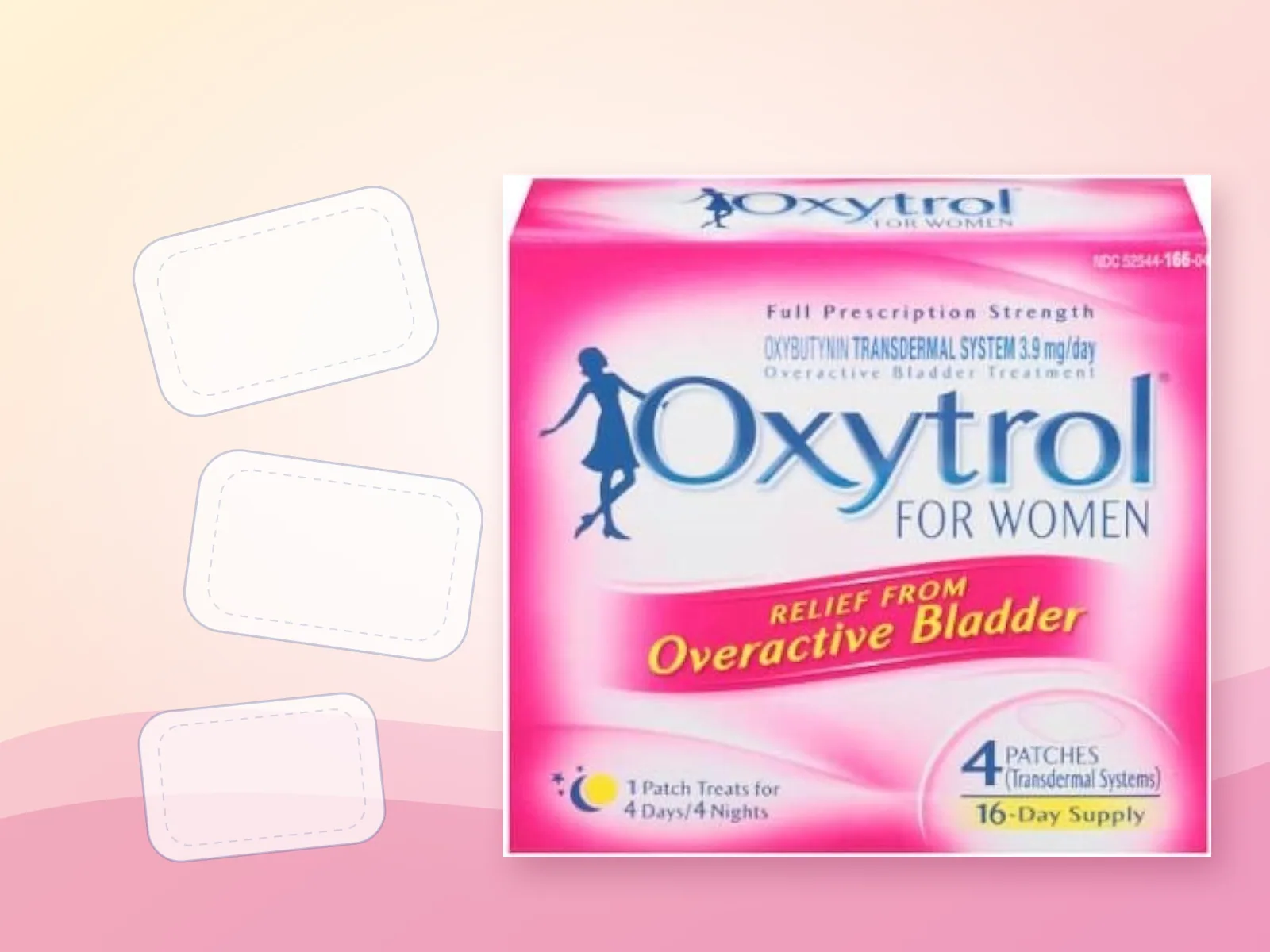
A box of 4 patches covers 16 days. Laid out on a calendar, with the place changing each time, it looks like this. The order of places is our example. The label asks only that you change the place with each new patch.
| Patch | Put on | Take off | Place |
|---|---|---|---|
| Patch 1 | Day 1 | Day 5 | Abdomen |
| Patch 2 | Day 5 | Day 9 | Hips |
| Patch 3 | Day 9 | Day 13 | Buttocks |
| Patch 4 | Day 13 | Day 17 | Abdomen |
Pick a way to remember the change day: a note on the calendar, or a reminder on your phone. The label does not prescribe a method. It prescribes the interval.
The last direction covers the patch that will not stay put. If it falls off and you cannot press it back onto your skin, use a new patch. Buyers report this from time to time.
I am applying it to clean dry skin with no oils or lotion on my skin
That buyer did what the label asks and still had patches lift. Others report the opposite, and say the patch held through showers. Reviews are single experiences. They cannot tell you how the patch will sit on your skin, and the label promises nothing about showers or swimming either way.
A label is brief, and some common questions have no line on the panel. It does not say how soon you might notice a change. It gives one mark only: 2 weeks without improvement means stop and ask a doctor.
It does not say whether to bathe or swim with the patch on. It does not say what to do with the calendar if you replace a patch early. For questions like these the box offers two routes: the consumer information leaflet inside the package, and the phone line in the last section of the panel.
The label is specific about what happens to a used patch. It gives two steps.
When you take off a used patch, fold it in half with the sticky sides together.
Throw it away so that it cannot be worn or swallowed by another person, especially a child, or a pet.
Folded, the sticky side is sealed against itself. A bin with a lid, out of reach, finishes the job.
Each patch comes in its own sealed pouch. The label says not to use a patch if the pouch is torn or opened, and not to store a patch outside its pouch. Open a pouch only when you are about to apply the patch.
| Line on the label | What it means at home |
|---|---|
| Product comes in individual sealed pouches, do not use if pouch is torn or opened | Check each pouch before you open it |
| Store between 20° to 25°C (68° to 77°F) | Normal room temperature, not a car in summer |
| Protect from moisture and humidity | A bedroom drawer beats a steamy bathroom shelf |
| Do not store outside the sealed pouch | No loose patches in a handbag |
This matters more when you buy several boxes at once. A pack of 6 boxes holds 48 patches, enough for 192 days. Keep them somewhere dry at room temperature, and check the expiration date printed on each box when it arrives.
The panel ends its list of contents with the inactive ingredients: acrylic adhesive, polyester/ethylene-vinyl acetate film, siliconized polyester film, triacetin. These are the materials of the patch itself, such as the adhesive that holds it to your skin and the films it is made of.
Most buyers never need this line. It matters if you know you react to a particular adhesive or plastic. In that case show the list to a pharmacist before you order.
The final section gives a toll-free line: 1-888-OXYTROL, between 9:00 AM and 5:00 PM Eastern Standard Time, Monday through Friday. The box also names its distributor. Our page about the brand has that record.
That phone line is the place for questions about the product itself. As an independent guide, we speak for the label and the prices, not for the company.
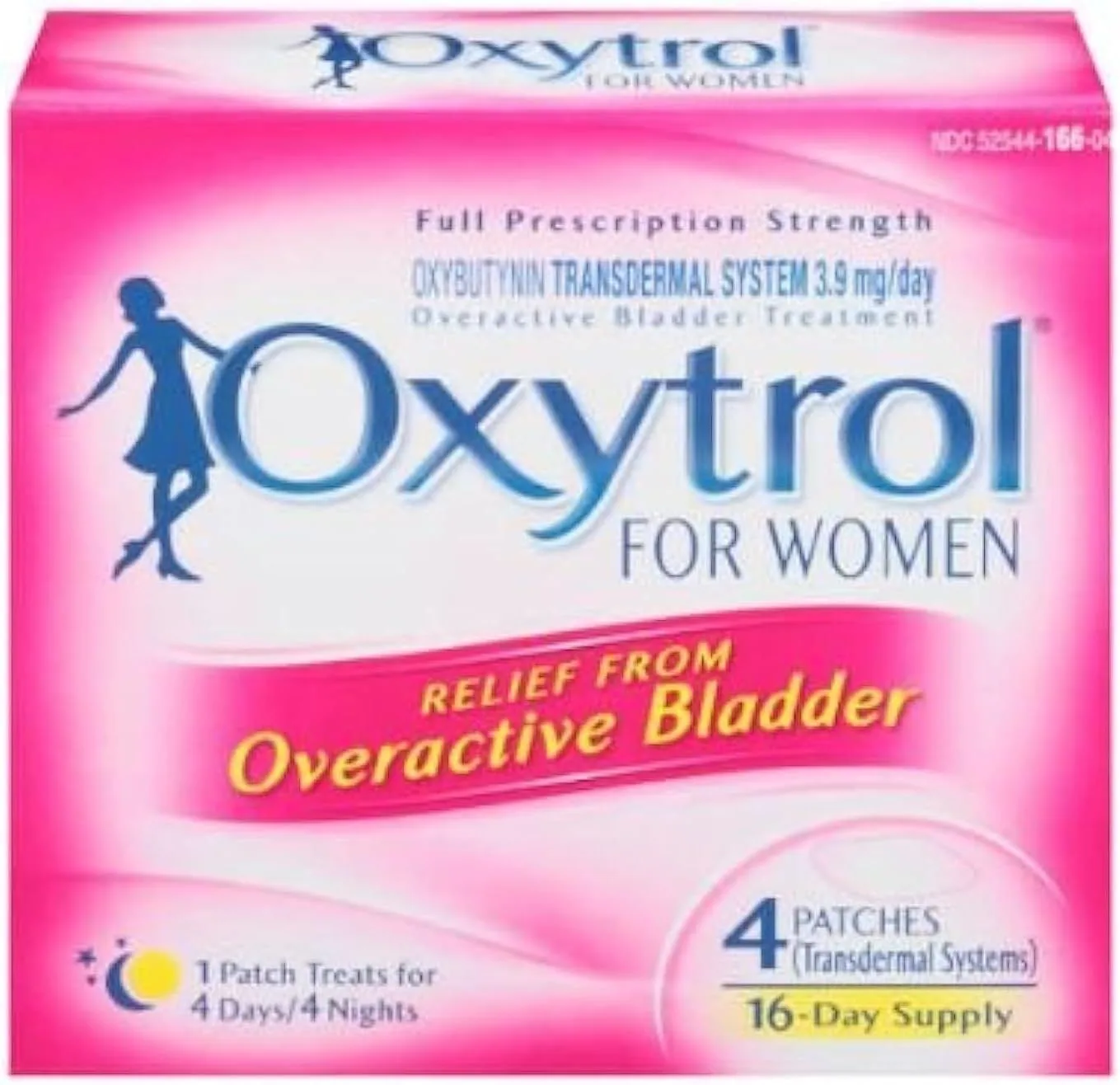
Two numbers on the label meet two numbers on the boxes. The label gives you 2 weeks to see whether your condition improves. The small box holds 4 patches, a 16-day supply. One small box takes you just past the mark.
Today 1 box, 4 patches of the 4-Patch Box cost $17.88, or $1.12 a day. It is not the cheapest way to buy a day of wear. It is the cheapest way to find out whether the patch suits you.
If it does, the 8-Patch Box covers 32 days, and its best pack brings a day down to $0.80. Across all 5 packs on sale a day of wear costs from $0.80 to $1.38. The arithmetic is in our guide to boxes and packs.
| Question | What the label says |
|---|---|
| Who is it for? | Women 18 years of age and older |
| What does it treat? | Overactive bladder in women |
| What is in it? | Oxybutynin 3.9 mg/day in each patch |
| How long is one patch worn? | 4 days in a row |
| Where does it go? | Abdomen, hips or buttocks, a new place each time |
| When do I stop and ask a doctor? | If the condition does not improve after 2 weeks, and in four other cases listed above |
| How do I store it? | At 68° to 77°F, dry, in the sealed pouch |
| Who do I call? | 1-888-OXYTROL, the line printed on the box |
Keep the box, or at least the back panel, for as long as you use the product. The panel is short enough to reread before each new box, and labels are revised from time to time.
Nothing here is medical advice. The article repeats a product label and public health sources. Read the Drug Facts label on your own box, and ask a doctor or pharmacist about your own case.
Sources read for this guide
Boxes and prices
Four patches or eight, every pack priced per day, and the case for starting small.
Options compared
Pads, bladder training, pelvic floor exercises and prescriptions, set beside the patch with sources.